What materials are F1 cars made of and why? Breaking down the engineering of elite performance

F1 cars are made using high-performance materials, designed to provide strength, while remaining lightweight. Some materials also need to be heat resistant, while others are compulsory for safety. From carbon-fibre to titanium, let’s discover what materials are F1 cars made of, and why.
The goal is to build a machine that weighs around 800 kgs, hits 350 km/h, and protects a driver through the harshest conditions imaginable. Let’s break down how this is achieved.
F1 cars are made using high-performance materials, that are designed to provide strength, while remaining lightweight. Some materials also need to be heat resistant, while others are compulsory for safety. From carbon-fibre to titanium, let’s discover what materials are F1 cars made of, and why.
Carbon-fibre – The primary F1 material
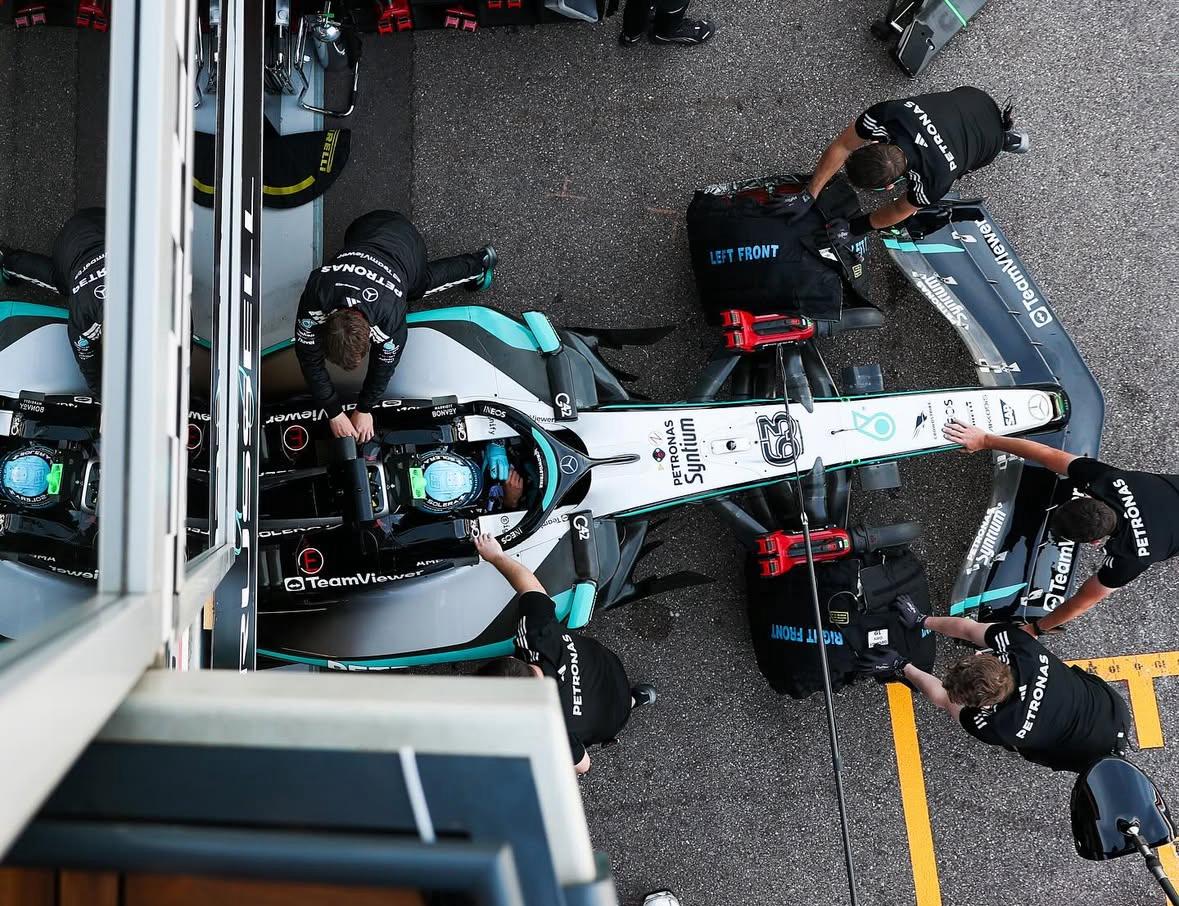
Almost 80% of an F1 car today is made out of carbon-fibre. At the heart of every F1 car is the monocoque chassis. This structure surrounds the driver and provides both rigidity and protection. This is made completely out of carbon-fibre on modern F1 cars.
Carbon-fibre reinforced polymer (CFRP) is about five times stronger than steel but much lighter.
It allows cars to weigh under 800 kg while still surviving massive impacts. In 2025, Mercedes also introduced a sustainable carbon composites. This newer material, made from eco-friendly resins, maintains strength while reducing environmental impact.
Brakes that survive extreme heat
F1 cars use carbon-carbon brake discs and pads. The optimal working window of these components is over 400°C. But, they can often withstand temperatures beyond 1,000°C during races. On the flip side, they don’t work well when cold. This is why race engineers often tell drivers to “warm up” their brakes before a crucial qualifying lap, or during a safety car restart.
Carbon brakes are much lighter than steel or iron (metals used previously). The reduced weight improves grip and stability of the car, and also helps reduce the overall weight, to fit within the regulations.
Balancing power and weight is essential in F1
Various advanced metals help balance weight, heat resistance, and strength on an F1 car. Titanium is used in suspension parts, fasteners, and wheel hubs. It’s lightweight and does not corrode easily.
Heat-sensitive areas like the turbocharger systems use Inconel, a nickel-chromium superalloy. It performs well at extreme temperatures. Aluminum alloys appear in the gearbox and non-load-bearing structures. These metals help save weight while still handling stress.
Safety-based materials
Driver safety is the primary concern when building an F1 car. It is impossible to stop F1 cars from collisions. And this is when the drivers are most under risk. Hence, teams are mandated to use certain materials in high-impact areas, such as side pods, wheel tethers, and around the cockpit.
Zylon is mandatory in cockpit areas and helmet visors. It is a strong material that can deflect debris away during crashes. Kevlar is a tough fibre, which is used in survival cells and underbody panels. It reinforces weak spots and helps absorb impact energy.
Every gram counts in F1. In summary, F1 teams want to make their cars lighter to achieve faster speeds and better fuel efficiency. They use heat-resistant metals around the engine and brakes, for better performance. And a few strong materials are mandated, to help protect drivers during crashes.
As of 2025, the materials used in building these machines are only getting more advanced, and we are likely to see more evolution as we go progress further.